
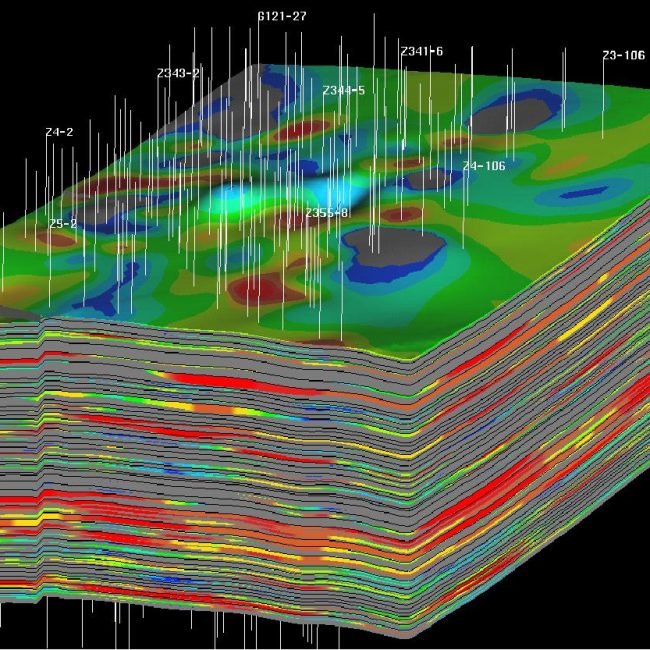
At Shreem Petrochem, our goal is to develop an integrated understanding of each reservoir to unlock its maximum economic potential for our clients. We foster close collaboration among various disciplines, data types, and concepts, ensuring a holistic approach to reservoir management. Our meticulous attention to detail goes beyond merely using a sequence of software applications; we emphasize true integration that combines geological, geophysical, petrophysical, and engineering data throughout the reservoir’s lifecycle. This comprehensive strategy enables us to optimize development plans and enhance recovery, delivering substantial value to our clients by reducing the cost, environment friendly solutions enhancing the economy of our country.
At Shreem Petrochem, we carry out Reservoir Simulation, Modeling & Subsurface Consulting, Reservoir Engineering and Geoscience Training Programs. We also working as System Integrators & Automation Solutions Providers as well as manufacturers of Digital I/O Modules and automation hargwares.
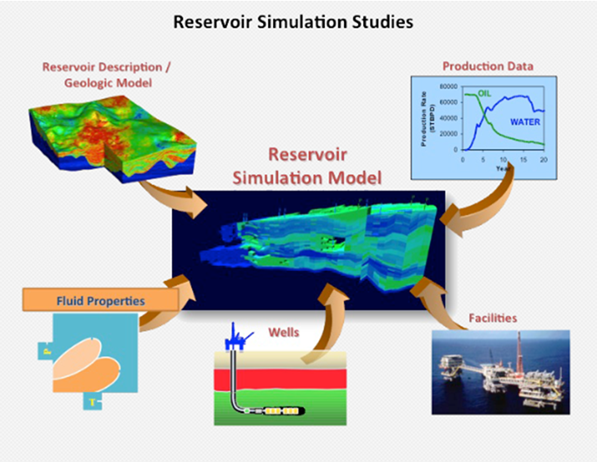
Reservoir simulation is an area of reservoir engineering that, combining physics, mathematics, and computer programming to a reservoir model allows the analysis and the prediction of the fluid behaviour in the reservoir over time. It can be simply considered as the process of mimicking the behaviour of fluid flow in a petroleum reservoir system (including reservoir rock and fluids, aquifers, surface and subsurface facilities) through the use of either physical or mathematical models. It’s a valuable tool to understand the oil and gas reservoir performance under various operating strategies.
To carry out reservoir simulation, it is necessary to perform several and complex studies which are normally made by teams of specialists from different disciplines – due to the large amount of data required for the preparation of the simulation input data set.
Traditional finite difference simulators dominate both theoretical and practical work in reservoir simulation. Conventional Fluid Dynamics (FD) simulation is underpinned by three physical concepts: conservation of mass, isothermal fluid phase behaviour, and the Darcy approximation of fluid flow through porous media. Thermal simulators (most commonly used for heavy crude oil applications) add conservation of energy to this list, allowing temperatures to change within the reservoir.
The simulation model computes the saturation change of three phases (oil, water and gas) and pressure of each phase in each cell at each time step. As a result of declining pressure as in a reservoir depletion study, gas will be liberated from the oil. If pressures increase as a result of water or gas injection, the gas is re-dissolved into the oil phase.
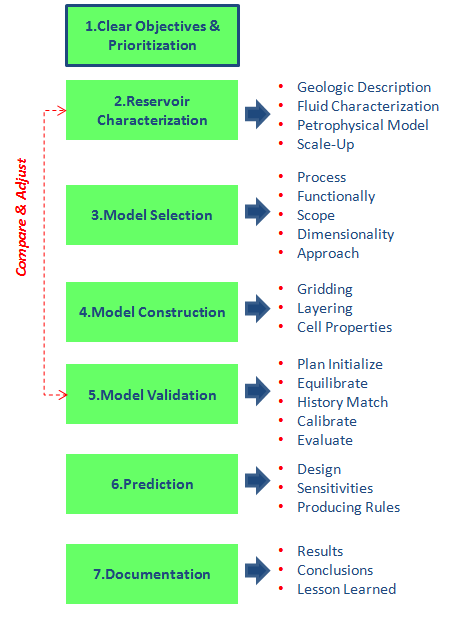
A simulation project of a developed field, usually requires “history matching” where historical field production and pressures are compared to calculated values. The model’s parameters are adjusted until a reasonable match is achieved on a field basis and usually for all wells. Commonly, producing water cuts or water-oil ratios and gas-oil ratios are matched.
Reservoir simulation models subsurface behavior, optimizing oil and gas extraction by predicting fluid flow, pressure, and reservoir performance over time. It enables efficient resource recovery, reduces costs, supports risk management, and informs critical economic and environmental decisions in the industry.
Reservoir simulation training builds expertise in fluid flow analysis, reservoir behavior, and modern recovery methods. Participants gain practical skills in Petrel, CMG, Eclipse, and other platforms, supporting optimal production and decision-making. Detailed course information is available on our training page for further exploration.
Geoscience and modelling integrate geological, geophysical, and reservoir data to create accurate subsurface models, predicting fluid flow, supporting exploration, development, and production planning. This enhances understanding of reservoir behavior, reduces exploration risks, and improves resource management in oil and gas operations
Subsurface consulting integrates geology, geophysics, and reservoir engineering to evaluate, model, and optimize hydrocarbon recovery efficiently.
Reservoir simulation reporting tools analyze model results, visualize performance, validate scenarios, and finalize development optimization strategies.
Delivering petrochemical solutions that ensure efficiency and growth for your business.
SHREEM PETROCHEM
A - 807, SAFAL PEGASUS, 100 FEET ANANDNAGAR ROAD, PRAHLAD NAGAR, AHMEDABAD 380015, INDIA.
GERMANY:
PARKSTRASE 16,
Wohnung Nr 92,
13585, BERLIN
Copyright © 2025 All Rights Reserved.
Disclaimer
The information and / or our technical advice and product information appeared in our website / brochure are based on our current knowledge, rigorous experience and given in good faith but without warranty. In view of many factors that may affect processing and application of our products, these data do not relieve users / processors of the responsibilities of carrying out their own experiments; neither do they imply any legal binding assurance of certain properties or of suitability for a specific purpose. The results of applications might diverge according to the conditions adopted. Preliminary tests are therefore advisable in all cases.
This website (www.shreempetrochem.com) uses images from various sources for illustrative purposes only. These images are the copyrighted property of their respective creators and are not owned by https://www.shreempetrochem.com. You may not reproduce, distribute, or otherwise use these images for any public or commercial purpose without obtaining the necessary permission from the copyright holder. For specific attribution, please refer to the image source or contact us if you have questions.